


On December 1, 2025, iHORN (a wholly-owned subsidiary of Zhong'anke Co., Ltd.), an ecosystem partner of HarmonyOS Smart Selection, announced the official launch of its first air quality monitor featuring StarFlash connectivity on the Huawei Mall and Huawei HarmonyOS Smart Home stores.
Indoor air quality directly impacts our health and quality of life. Whether addressing formaldehyde risks after home renovations, ensuring respiratory safety in nurseries, or monitoring daily air quality in offices and vehicles, users increasingly demand “visible peace of mind.” The iHORN Air Quality Monitor was developed to meet this need, committed to delivering reliable air health management through precise monitoring and intelligent connectivity.

At this year's Huawei Developer Conference 2025 (HDC 2025) keynote, Richard Yu, Huawei's Executive Director and Chairman of the Consumer Business Group, announced the rebranding of the HarmonyOS smart hardware ecosystem to “HarmonyOS Smart Selection.” iHORN became one of its first ecosystem partners.
This collaboration enables iHORN air quality monitors to deeply integrate into the HarmonyOS Smart Connect ecosystem. Users can view real-time air quality data and receive anomaly alerts via the Smart Life app, while enabling scene-based interactions with air purifiers, air conditioners, and fresh air systems to establish a closed-loop “detect-alert-improve” air management system.

Richard Yu, Huawei Executive Director and Chairman of the Consumer Business Group, delivering a speech at the conference
Precision Monitoring
iHORN's air quality monitor focuses on four key indicators: formaldehyde, carbon dioxide, temperature, and humidity. Three core technologies ensure data accuracy and stability.
High-precision detection chips equipped with Huawei HarmonyOS Smart Home adaptive algorithms perform real-time compensation and fusion processing for each sensor signal. This ensures stable detection even in complex environments, with interference resistance improved by 17.9%*.
Our proprietary 60-point precision calibration technology delivers over twice the calibration points compared to industry-standard 18-point calibration. These calibration points function like ruler graduations—the more numerous and densely spaced they are, the more precise the measurement results. Combined with sensor self-learning and self-calibration capabilities, this boosts detection accuracy by 66.5%*, ensuring the device becomes more precise and reliable with prolonged use.

In structural design, iHORNconducted 55 airflow and thermal simulation tests to optimize airflow and heat dissipation, achieving a 58%* improvement in overall stability.

Whole-Home Connectivity
As the industry's first air quality monitor supporting StarFlash connectivity technology, the product achieves breakthrough improvements in connection speed, stability, and power consumption, delivering a smoother network setup experience for users.
Deeply integrated with HarmonyOS Connect, the device supports multiple smart scene integrations, empowering users to build a comprehensive intelligent air management system. It transforms “invisible” air quality into a visible, manageable, and actionable part of daily life.

Formaldehyde Removal: When the iHORN air quality monitor detects excessive formaldehyde levels, it automatically triggers the air purifier to activate purification. This eliminates the need for frequent window opening by newly renovated users, saving time and effort.
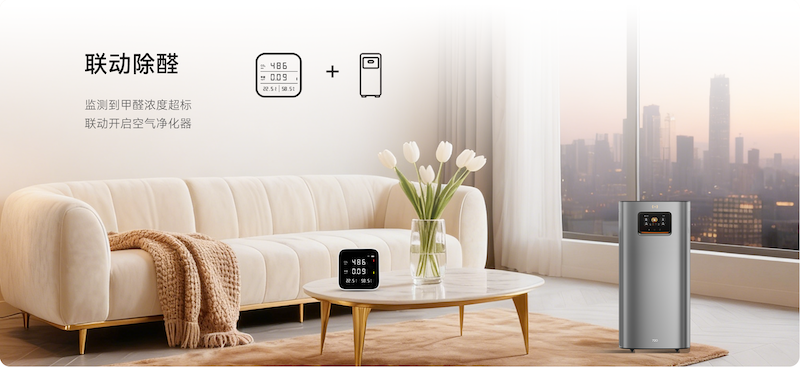
Oxygen-Enriched Sleep: Upon detecting elevated carbon dioxide levels, the iHORN monitor automatically activates window openers for ventilation. This ensures a night of oxygen-rich air without disrupting sleep.

Constant Temperature & Humidity: When the iHORN air quality monitor detects abnormal temperature or humidity, it automatically activates the air conditioner or humidifier to create a comfortable home environment and safeguard family health.

Thoughtful & User-Friendly
iHORN prioritizes the actual user experience in product design, dedicated to transforming professional sensors into easy-to-use, user-friendly home devices.
To enhance readability, the product features a high-definition large screen with clear, intuitive displays. It supports an ultra-wide viewing angle of 170° horizontally and 130°* vertically, allowing users to easily read data from various angles. Additionally, the 365-day data storage function clearly records detection data and trend changes, making the effectiveness of home air management clearly visible.


As the first air quality monitor utilizing radar-based human presence detection, it delivers a seamless, unobtrusive interaction experience: the screen illuminates when someone approaches and dims when they leave, significantly enhancing convenience. The screen's dynamic response minimizes distracting light sources, contributing to a relaxed and comfortable home environment.
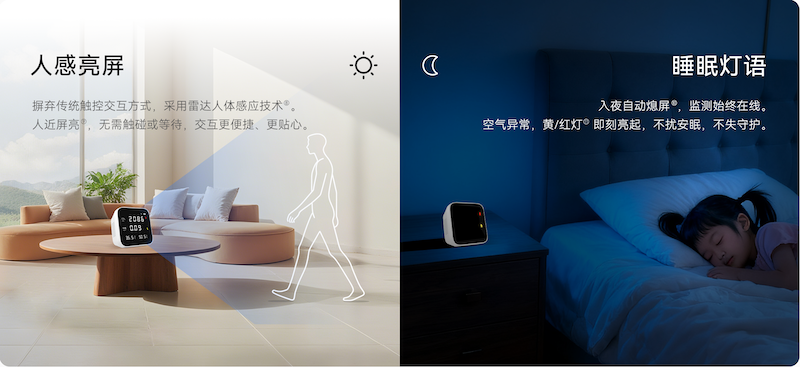
To visually indicate air quality changes, the product features a dual-color light system: yellow for pollution exceeding standards and red for severe exceedances. During daytime, both the screen and lights provide alerts. At night, the device automatically enters sleep mode, dimming the screen while retaining gentle light cues—balancing reliability with thoughtfulness.
Peace of Mind Protection
From raw material screening and cross-contamination testing to cleanroom assembly and anti-pollution encapsulation, iHORN enforces stringent quality control throughout production. This minimizes sensor contamination risks, ensuring long-term monitoring accuracy and device longevity.
iHORN delivers not only precise air data but also safeguards users' healthy living. When homeowners move into new residences with confidence in reliable readings, children thrive in wholesome environments, and nights bring restful sleep with oxygen-rich air—these subtle yet tangible transformations embody the enduring value iHORN strives to achieve.
Effective immediately, iHORN air quality monitors are available for purchase on the Huawei Mall and at Huawei HarmonyOS Smart Home stores.
Good air quality—see it to believe it!
*All data cited in this article originates from iHORN laboratories.